Products · NSight Private Credit
Close the quarter once.
Load borrower financials into NSight Private Credit and instantly calculate covenants, ASC 820 marks, Form 468 filings, and stress scenarios. Deterministic, fully auditable, and deployed in your cloud - your data stays private, and you stop paying vendors to access it.
Scroll to follow the quarter →
[01] Dashboard
The whole book, and which basket you are reading.
Commitments, fair value, breaches and watch status for the whole fund on one screen. Every figure is computed at read time from filed inputs. Nothing is stored as a result, so nothing can be pasted over, and a status that is an analyst's judgement is shown as one, beside the derived rationale, never confused with a computed breach.
covenant tests in breach across six borrowers and four quarters, each traceable to the rule that fired.
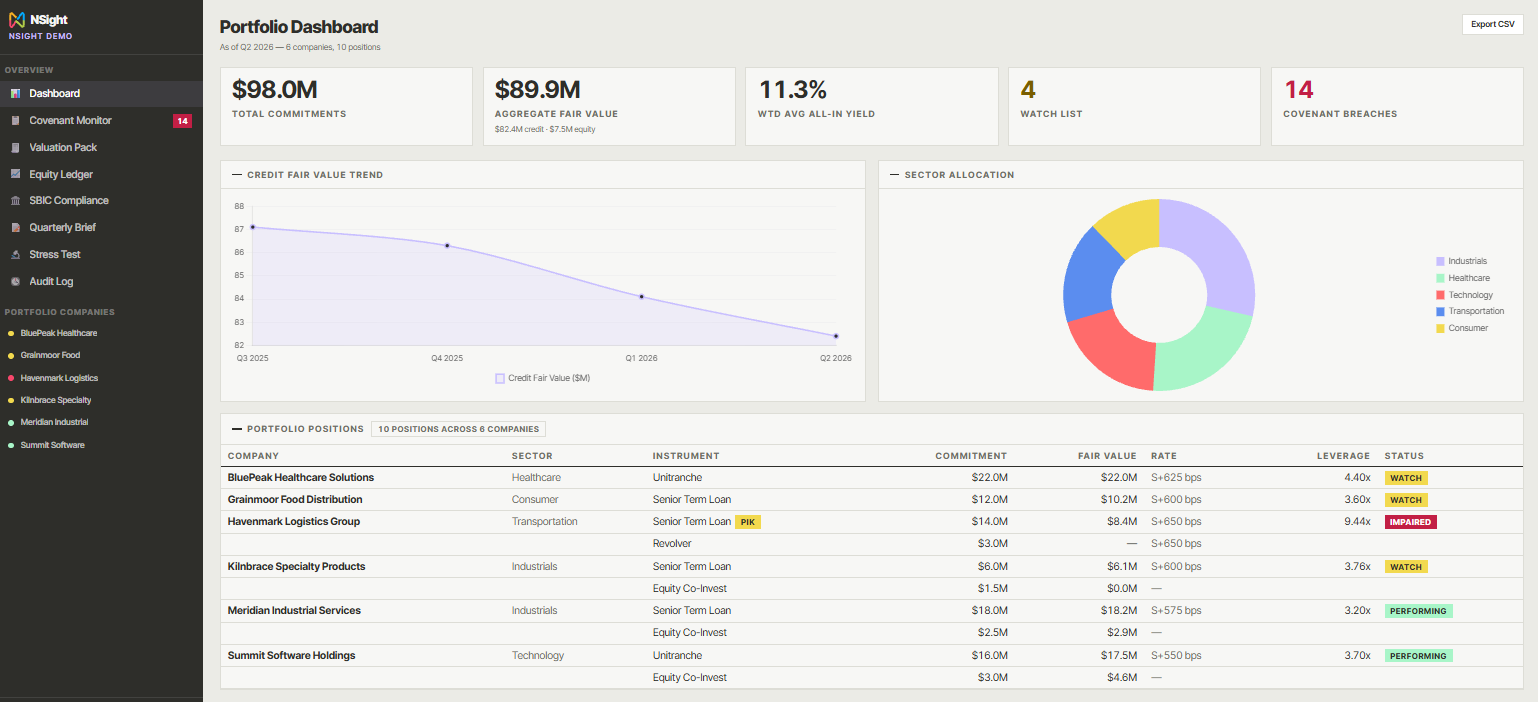
Dashboard · six borrowers, ten positions
[02] SBIC compliance
The number you filed, not a second one that argues with it.
The Form 468 calendar and the capital impairment measure against amortised cost, including PIK accretion, are derived from the same inputs as every covenant test and mark. Headroom against the leverage test is shown before the SBA sees it. Any figure NSight does not compute is shown as filed, never estimated.
the SBA leverage test, computed from the same financials as the Form 468 filing, so the two can never disagree.
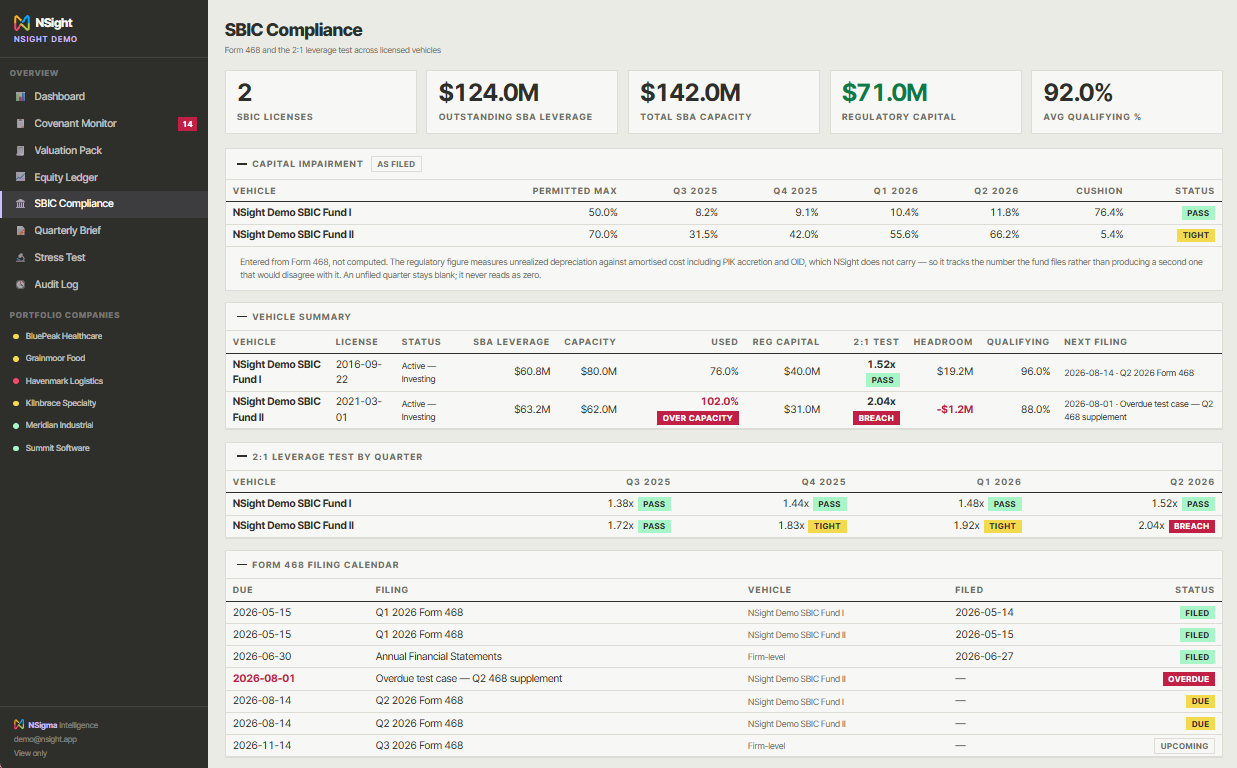
SBIC compliance · two licensed vehicles
[03] Equity co-invest ledger
A write-off is a 0.00×, and never a 1.00×.
Warrants, kickers and co-invest positions sit beside the credit they came with. When equity is written off, the event is recorded with its date and reason, and the credit position beside it continues to be tested and marked.
credit and equity held in one ledger. A write-off is an explicit dated event with a reason, never a deleted row.
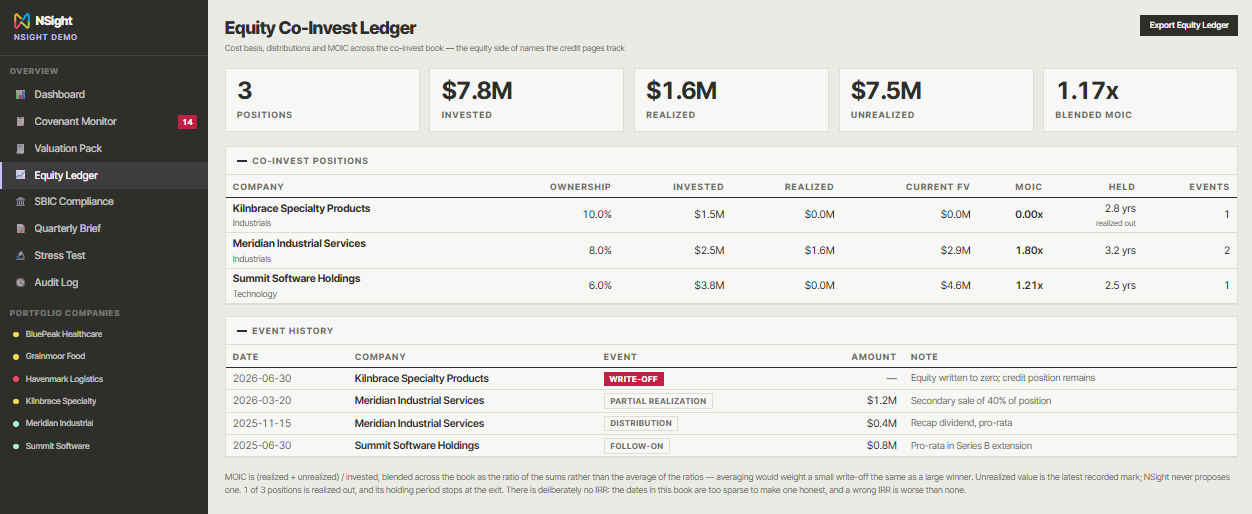
Equity ledger · three co-invest positions
[04] Portfolio stress test
Move a slider, and every covenant recomputes.
Apply revenue, margin, interest rate and debt shocks across the book and see which covenants break, in which quarter, under which scenario, on your own assumptions. A scenario is a different set of inputs run through the same rules, so the result is as defensible as the base case.
covenant tests recomputed each time a slider moves.
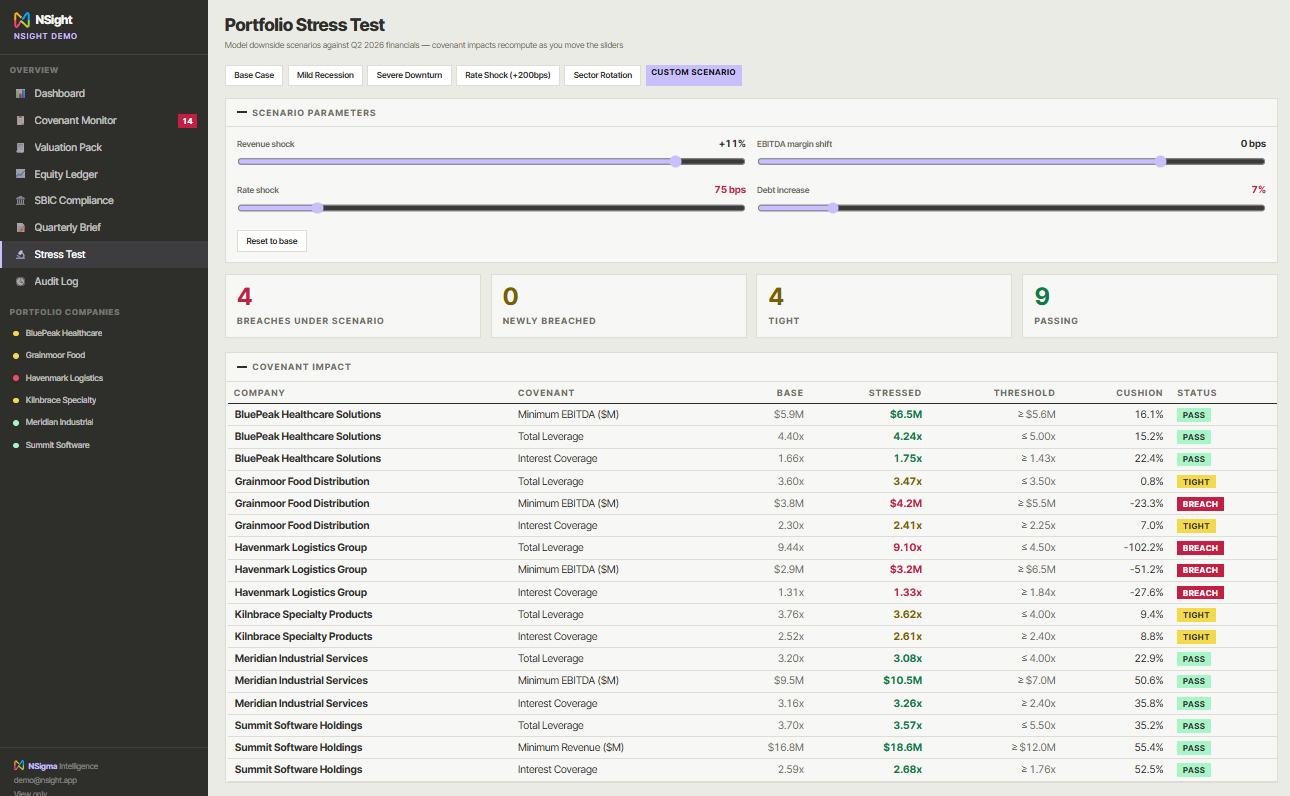
Stress test · every covenant, one scenario
[05] Also in the licence
Three more screens.
NSight is not built on a language model. Reading a figure out of a PDF is a job for AI. Deciding whether a covenant passed is a job for deterministic code that returns the same answer every time and can show its work.
[06] How you buy it
Licensed, not engaged.
NSight Private Credit, explained
See risk earlier.
Tested against the threshold in force at the time.
The demo is the same build.
Six borrowers, ten positions, four quarters. One of them is deteriorating in a way you will recognise. No form, no call in the way, nothing to install.